Soooooo anyway: Dogman

My kiddo decided he wanted to read the Dogman series by Dav Pilkey when he was eight. I was not excited. Like the Super Diaper Baby books that came before it, Dogman looked gross, silly, and inane. 

I have never turned down a request for a book by a child, however, and did not plan to start with Dogman. We got a copy of the first book and started reading. 

Welp. I realized upon gazing at the cover that Dogman is a cop. Fuck. We started the book anyway, but I complained about copaganda. (Dogman, for the record, is not copaganda.) And to be fair, Dogman only has the body of a cop. He has the head of a dog. 

We’ve now, over a year later, read every Dogman book, plus much, much more by Pilkey. Despite that inauspicious start, I am actually a bit of a Dogman connoisseur. So here is my analysis, as a teacher, a mom, and a human person.

Dogman is not for you

Unless you are an elementary school age child (get off my blog, please), Pilkey didn’t write these books for you. He wrote these gross jokes, silly characters, and zany plots for the ADHD boy he himself was. The OG frame story really reveals the tale: young boys Harold and George write and illustrate Dogman. If there are too many poop jokes and you don’t like the page flipping action, well, it was, in the fiction of the book, written by kids for kids. Eventually, the Dogman books drop the frame, so we no longer get reminded of Dogman’s authors, but that doesn’t really matter. 

Lil Petey, a child character who turns out to be the heart of the Dogman series, although he doesn’t appear until Book 3, takes over from Harold and George. He makes a lot of the silly, bodily function jokes and plagues his father with endless why questions. And just so you know, Lil Petey is a cat, who eventually adopts the moniker of Cat Kid and inspires a whole spin-off series: Cat Kid Comics. Lil Petey ends up with a robot companion called 80-HD, which also speaks to Lil Petey’s– and Pilkey’s– appeal. There is something playful, subversive, and youthful about using an adult term like ADHD and reframing it to sound like a cool name for a robot. 

Lil Petey

So some of the humor, the action-packed scenes, the rambunctious pace, they are not really objects of critique; rather, they are evidence of this series’ audience. And, in all likelihood, that’s just not you. 

Still, Dogman might be for you

On the other hand, I’m a grown-ass woman. And I can tell you, unabashedly, that Dogman is for me. I am a lover of cats in media, and when Petey the Cat, supervillain, makes his appearance in the first book of the series, it wasn’t hard for me to like him. To be clear, he’s definitely the bad guy. But he’s a cat, and he’s funny and clever. I’m a sucker. 

And then. 

One’s experience with media is linked to one’s internal life. That’s how reading works. Some texts might mean more or less to you at different times of your life, for example. For me, Petey’s story came at a time with I was grappling with grief over my dad’s death, as I tried to process who he was as a person. Petey, despite being a children’s book character, has an arc in which, first, he has a child (the aforementioned Lil Petey) (by a process of cloning– it’s part of a supervillain plot), has to figure out how to be a dad unexpectedly, and engages with his own father, who abandoned him when he was a kitten and eventually returns in the series. 

Petey

I was deeply moved by the story, as my partners and my kiddo can attest. I shed some pretty intense tears over a cartoon cat. To give Pilkey the credit, he’s a gifted writer. He developed a thoughtful storyline for Petey, and the illustrations of some of the scenes as he makes realizations about his life are gorgeous. 

Petey’s the best example, but he’s not the only example. There are other characters with stories that are intense and engaging; and, of course, there are others that are zany and silly. 

About 80-HD

Neurodiversity plays a more significant role in the Dogman series than a surface glance might reveal. Lil Petey’s robot companion 80-HD offers one clue, and Pilkey’s notes at the end of the books are even more overt. Pilkey was an ADHD child who had a lot of trouble in school. He talks about his teachers putting his desk out in the hallway… where he happily wrote comics instead of doing his schoolwork. 

It’s been a genuine pleasure to see my own ADHD kiddo laugh at the name 80-HD and experience a world where neurodiversity really is a superpower. And I’m not saying that neurodiverse brains are superpowers or taking that overly positive view, by the way. I know, from my own neurodiverse experience, that the world isn’t made for those us with different brains, and it’s very easy to take a deficit view of brain differences. It’s pleasant, though, that Pilkey doesn’t have a deficit view. 

Although there are lots of good children’s books about neurodiversity, Pilkey pulls off something that is more unusual: instead of demonstrating that a neurodiverse brain, like an ADHD brain, is cool and that we should respect differences, Pilkey just makes a world where it really is great to be ADHD. This is a world where folks hyper-focus, get distracted, engage in creative, connected activities, and bond with other neurodiverse folks. Pilkey’s twist is really the opposite of a deficit model because he’s saying, see, it’s the world that’s the problem, not your brain. 

Maybe that’s a thing that’s good for neurodiverse kids and adults to hear. 

About copaganda

Above I parenthetically noted that Dogman is not copaganda, but let me give you my argument on that. After all, the titular Dogman is a cop. He’s not a good cop (though he’s a very good boy), but he’s a cop. That, on the spectrum of cop-centric media, is sufficient to weigh a text toward copaganda. As much as I adore shows like Monk, Elementary, and The Mentalist, they are all copaganda in that the cops are essentially good and necessary and doesn’t society really need them to hold this whole thing together? 

And yeah, we kinda do. If by “this whole thing,” we mean the capitalist hellscape in which we currently exist. Cops uphold the status quo literally, as defenders of landlords and rich folks and slavery. 

So why isn’t Dogman copaganda? Dogman does not reify the status quo; in fact, Dogman does not make an argument for stabilizing institutions at all. Prisons are destroyed, city halls are destroyed, plenty of objects of power and violence are demolished. In Dogman, cops don’t and can’t maintain the status quo. In Dogman, that’s not a valuable thing to even do. 

And it’s not just institutions. Characters in Dogman are dynamic. Judges, cops, and mayors may turn out to be supervillains just as much as green scientists, cats, and cybernetic fish. Dogman presents to us a dynamic world in which people are capable of change. Petey begins his life in Dogman as a supervillain, and now he’s a dad and a good guy. The cybernetic fish follows a similar path from villainy to dadhood (in his case by adopting 30 psychokinetic tadpoles, as one does). 

So yeah, Dogman ultimately presents a more hopeful, just world. Also, lots of poop jokes. A whole lot of poop jokes. 

Oh yeah, here’s Dogman

Top. Ten. Movie. List.

Note: I’m working on more serious post, but I have a personal goal to post every Friday. So here’s some popcorn reading! (Heh.)

Another note: These ratings are mine and mine alone. Your mileage won’t just vary; you will run out of gas, if you think I’m offering any kind of metric beyond, these are movies that I like. I’m inspired by Nick Hornby’s High Fidelity

Honorable Mentions

Initially, I had both Ratatoille and The Princess Bride on my list, and both of them just got squished out by other films. I love that Ratatoille is about the pleasure of food. That moment when the critic eats the ratatouille is transcendent. Plus, it’s about class. This is easily my favorite Pixar flim. And I can quote every word of The Princess Bride– that’s worth a mention!

My other honorable mention is really a scene. Quicksilver’s scene (you know the one!) in X-Men: Days of Future Past is really a perfect scene. The Pink Floyd t-shirt, the soup-tasting, the daddy issues. No notes. It, unfortunately, is placed in an otherwise meh movie. 

#10 Children of Men

This 2006 fim is dystopian and pretty bleak. It may not be your top choice for pandemic viewing either. But this film is ultimately about hope, which is a topic that means something to me. I still think about this movie often, years after seeing it, and that’s one of the ways I judge how much I like a film.

#9 12 Monkeys

All of the stories about Bruce Willis and the disability issues he may be grappling with are pretty sad. This science fiction movie is probably my favorite Willis film, even including Die Hard and Pulp Fiction, both of which I liked (on recent rewatches, Die Hard stands up and is a Christmas movie; Pulp Fiction doesn’t hold up as well and is not a Christmas movie). 12 Monkeys also stars Brad Pitt in his second best role (the first is True Romance: “Get some beer! And some cleaning products.”). Down side: this movie is a downer.

#8 Spiderman: Into the Spiderverse

I’ve already written a blog post on this one, but several years later it remains a thoughtful film and one I’m always happy to rewatch.

#7 Mad Max: Fury Road

Alternate title: The Smart Girl’s Guide to Surviving a Dystopian Hellscape.

#6 Moulin Rouge

Oh, now we get to the controversial choices. Plenty of folks despised Baz Luhrman’s musical when it came out, and I’m assuming that it’s still not well-loved. But this is my jam. Renditions of popular songs woven into the plot? Ewan McGregor as a poor, heartsick writer? (Also, shout-out to McGregor, who is apparently getting dragged for saying racism isn’t welcome in Star Wars. Come on, fam. I already wrote about The Last Jedi, too. Suck it.) Overwrought plot and love story? Yes, yes, yes.

#5 Jurassic Park

Here’s the thing. I love this movie irrationally. I liked Michael Crichton’s Jurassic Park, I like dinosaurs, I like Jeff Goldblum, I like Laura Dern. Honestly, it’s fine that the movie killed off Muldoon and Gennaro. Big game hunters and lawyers are not heroes. Mathematicians, sure! The movie manages to take a lot of very good things and make them great. 

If I may wax further poetic, the great thing about Jurassic Park is that the dinosaurs are not the villains. This is a story about institutions, power, control, money, and knowledge. The flaw of the movie is imagining Hammond as a sweet grandpa instead of the capitalist caricature that the book correctly understands him to be. 

Still, that Jell-O. The velociraptors sliding across the kitchen floor. “Clever girl.” Hell, I’m going to watch it again right now.

#4 Amelie

I’m back! Very different from Jurassic Park is Amelie, which was a formative film for me about sex, pleasure, and identity. I also enjoy watching it in French.

#3 John Wick

John Wick is a perfect film. Fight me. (Just kidding, I’m not John Wick, please don’t fight me.) I feel like this is a movie that understands what movies are supposed to be. I am also a sucker for the world-building that gets expanded in the sequels.


It’s also cool in the sense that the more you know about John Wick, the more there is to like about it. Keanu Reeves did his own stunts, for example. Movies with Mikey has a great video on the background!

#2 The Matrix

I’ve called The Matrix my favorite movie for years, probably since I saw it at the dollar theater during its first run. Like the Wachowski sisters, I’m endlessly shocked and angered that certain people (you know who they are) can so egregiously misread this text, and I’m glad that that Revolutions makes it abundantly clear. This film is unabashedly trans and queer, and it holds up to modern viewings.

#1 Arrival

Do you ever feel sadness that is built up in you, sometimes for weeks, and that sadness might be for a specific reason, or it might just be universe-sadness? When I was a kid, I used to feel that build-up and then read Charlotte’s Web. I’d just sob and sob at the end of the book. Now, as a grown-up, I watch Arrival for the same catharsis. 

It’s beautifully, painfully, gutwrenchingly sad to me. But this movie to me says what I feel about the world and relationships and being alive, which is: it’s all so hard, impossibiy difficult, and yet, given a choice, I’d choose it. I’d choose all of my same struggles because I think that being a human is wonderful and perfect, both when it’s joyful and sweet and when it’s wretched and painful. The film also connects these human experiences with language and communication, juxtaposing human communication with alien language in a way that speaks to me and my interests very closely. 

Jesus, I’m sobbing right now just thinking about it. When I first drafted this list, Arrival was lower down, but, as I write this, I have considered what this film means to me and promoted it. I know that earlier I mentioned 12 Monkeys being a downer as a sort of demerit; Arrival is sad, but it’s not a downer. Arrival loves humans and life and pain. It’s important not to conflate sadness with a dearth of hope.

Anyway, that’s the end of my list, which, per Hornby, says more about me than these movies. But y’all are welcome to have at it in the comments! I also welcome recommendations. My movie experience is pretty weirdly spread out, like a gerrymandered red state district, and I’m open to expansion.

a dream of chaos

content warnings: self-harm, suicide, general sickness and medical issues

A weird realization I’ve had after spending a lot of my time this week in the hospital: one of the things I miss is clutter. My home is full of clutter, something I’ve generally felt pretty bad about. Little piles of papers, a box of Magic cards, a notecard cut up into tiny squares for some reason, the spices I use most frequently scattered on the counter, Animal Crossing device controllers, books, my clean laundry occupying half the bed. I often think that I should reorganize for a less clutter-filled life.

But that comfortable clutter represents my actual life. Not the cleared countertops and put-away clothing and boxes tucked away that guests experience, but my real life strewn about, in easy reach, representing the things I love. Marie Kondo would understand; these things bring me joy. 

It’s complicated, though, and, if I’m trying to be easier on myself about the clutter, I’m also highly aware of how clutter can come to represent something much more problematic. I’ve spent too much time at my dad’s house these past few months to be able to think about clutter without worrying over my future in cluttered living. His house is more like something you’d see on TV on a reality show, the sort of place that would give Kondo pause. His bedroom is just piled with clothes on the bed and in the wardrobe and closet; he must have been sleeping only on the couch and in his truck for years. There is literally a pathway wending through the downstairs area. Stacks of boxes teeter, piles of drafts and papers looming on all sides. Machines, more boxes, an actual motorcycle. It’s– troubling. 

Acorns on a pan. Why?
I’m not including the more graphic pictures here, but this one is the inexplicable acorns on a baking sheet I found in my dad’s house.

But here in the hospital, I’m learning to think about Aristotle’s golden mean with more understanding. The clear, empty floors make me long for my floors, lined with my kiddo’s toys, my running shoes, and all of my yoga equipment. The glistening counters make me think of the coffee cup I left out four days ago and how much joy it brings me just to see it there, even when I haven’t tidied it. Everything is white and gray gray gray, and my vibrant clutter seems much more appealing in comparison. 

My cortisone levels were surging when we first got here; my offspring’s emergency surgery, a lingering infection, and a litany of mini crises will do that. Today, on day six, I’ve been thinking of my dad. It doesn’t help that my sweet child here looks just like him. And I’m thinking of my father’s last days in a hospital, not this one, but certainly similar in feeling. Did he long for his vibrant clutter? Did he think of some particular tottering pile of papers and think, gosh, I hope it doesn’t fall over. I’ll lose the order of the pages. 

He asked the doctors to kill him in the end. That’s what he always told me he’d do; well, he told me that he’d do it himself if he were dying. “I’ll shoot myself in the head,” he told me once when I was maybe 20. 

But he didn’t. He died alone in a hospital room, probably not one dissimilar to this one, where I’m sitting now beside my suffering child. 

Here’s the truth though. When I first thought of my dad this morning, I wasn’t thinking of him at the end, in a hospital bed refusing to be intubated. I thought about him when I went down the hallway to cry by myself for a while and tried to remember something that would make me feel better. When I was younger and worried or scared, my go-to image was of my dad. He always sent me flowers on my birthday, and I bought him socks for his birthday every year. Thinking of him and the flowers he always remembered to send and the socks he always immediately started wearing were thoughts that, once upon a time, made me feel better. 

Statue above a toilet. Why?
This is the statuary in the upstairs bathroom of my dad’s house.

Last time I was at his house, I found an open bag of socks, just like the kind I used to send him, and they looked old enough to be those. And I can understand how comforting clutter can become immoblizing clutter, the kind of clutter that feels impossible to remove or even to want to remove. 

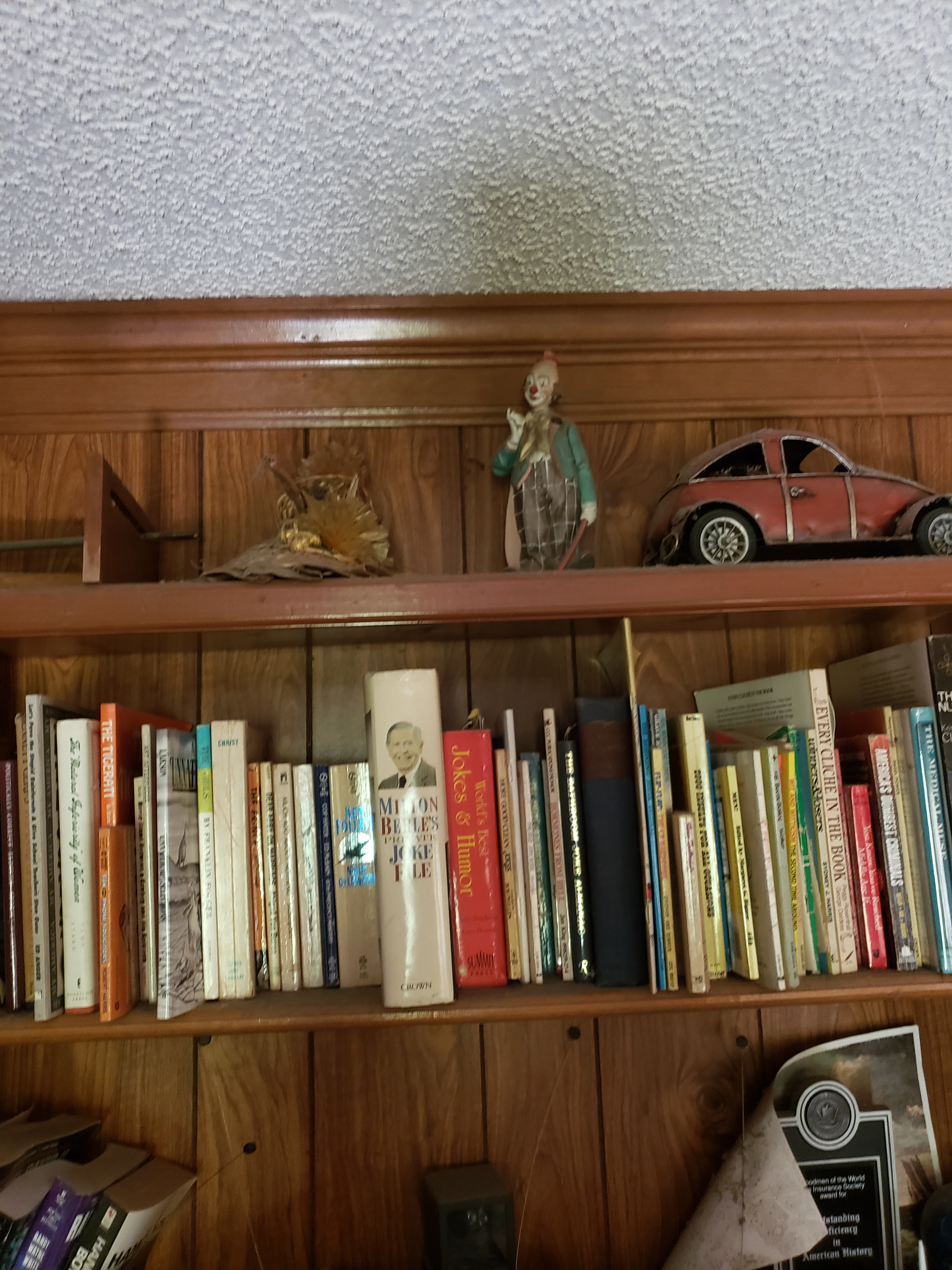
And it’s not even a metaphor: home clutter reflects brain clutter. My dad’s house is full of fascinating clutter, from chess sets and notebooks full of scribbled poetry to horrifying porcelain clowns and indecipherable machines. It’s full of puzzling clutter: an entire pot full of keys, a pan scattered with acorns, notes stuffed into pill botttles. Then there are the other kinds… the shattered glass on the porch, the hundreds of empty cat food cans, the piles of mail weighing down the table. I understand, not academically, not intellectually, but visercerally, how one gets there. 

I’ll conclude by adding another complication here, this one via Michel Serres and the concept of “noise.” Serres’s noise is a complex concept, and for now I’ll just say that he describes noise as being any unintended texts that are mixed up with a message. That is, in writing this essay, I intend a particular message, which I’ll post on my blog. When you, dear reader, encounter my blog, you also have to accept the noise that includes ads on this webpage, language differences between me and you, the constraints of the medium itself, and a plethora of other possible things. Sometimes, the noise and the message are inextricable to the reader. Communication is only possible because of noise, but noise also makes it impossible for the rhetor and audience to perceive the same message. 

Clutter is a physical version of noise (which Serres also calls the parasite). As a person, I mediate the world through material possessions, and my existence is only possible because of them. This clutter both contributes to my existence and makes it more challenging for me to decipher physical signals in the world. The answer is not to eliminate noise or clutter (one can’t), but also to recognize the generative qualities of noise/clutter. Change and possibility emerge from dynamic spaces, and clutter/noise is an aspect of that dynamism. 

Eventually, I’ll cultivate this thinking further, and see how it aligns with the work I’m doing around the philosophy of hope. For now, I’ll sit in an uncluttered space and dream of chaos.

A clown looks at you from the top shelf of a bookshelf full of books and knick knacks.
A troubling clown gazing down from the top of my dad’s bookshelf.

“Welcome to My House”: Flo Rida’s Magic Circle and the Politics of Possibility

I’ll get the obvious out of the way first. Yes, sure, Flo Rida’s party anthem “Welcome to My House” can absolutely be read as the invitation to a pretty cool party and night of sexual exploits that it is. There’s champagne and music and clothes on the floor.

But come on into my house. We can enjoy that reading of “Welcome to My House” while also acknowledging another level of meaning to which Flo Rida’s lyrics also invite us.

“My house” is the setting of an experience initially described by the speaker, a magic circle where the speaker defines what will happen there. The first line of the song is “Open up the champagne, pop!” with that pop at the end not a sound effect, but an onomatopoeia voiced by the speaker. This is an invitation into a world where the experience is built, not a previously existing reality. Later the speaker suggests that you “Close the blinds, let’s pretend that the time has changed” because this is a world where play and pretend are welcome and possible. Furthermore, the speaker suggests that these rules can run contrary to rules in the dominant culture. “Play that music too loud,” they repeat.

That magic circle is not entirely inscribed by the speaker, however. They invite “you,” the invited “baby” to make the rules as well. “Baby take control now,” the speaker suggests, as well as “mi casa es tu casa.” The house of the speaker is a place of play and shared control.

Speaking of play and shared control, Flo Rida’s ideological cousin Michel de Certeau suggests in The Practice of Everyday Life that there are ways for people use tactics that act against the oppression the dominant culture. Tactics are not revolutionary, and people are not acting overtly against the larger systems of oppression when they enact tactics; instead, they find ways of carving out their own meaning within those systems.

The consensual play-space of “my house” in “Welcome to My House” is an example of such a tactic. In “my house,” the speaker could easily act in dominance and dictate a set of rules. They don’t. Instead, they create a space that invites other voices to participate in the experience and creation of the shared world. “You” are not expected to follow the speaker’s rules; “you” are invited to come in and “take control” or to “yes and” the speaker’s world.

There is possibility and opportunity for us here. In the spaces where we have power, we often have monarchical tendencies, to make our own space. Our workplaces, our homes, our social structures are all spaces where we might exercise some level of influence and power. It’s a tactic, a way of acting against oppressive institutions, however, to turn those spaces into spaces where we share power and make-believe with those we welcome into our spaces. As a teacher, I invite students to “my house,” and though it would be much easier just to make the rules and enforce them, when I do so I am only reinscribing the dominant culture on my students. As a mom, it would be easier for me to demand obedience, instead of inviting my children into our own shared creative space. As a partner, it’s easier for me to perpetuate heteronormative, gendered discourse in my familial and romantic spaces, but it’s more liberatory to invite my partners to invent new modes of communication and behavior with me.

We all have different levels of freedom from which we operate within institutions; my femininity, my queerness, my cisgendered identity, and my whiteness all offer me a nuanced range of constraints and allowances within any given system. De Certeau’s idea of tactics, though, offers us the possibility of being able to act against institutions, even when we are still operating within them. Because “sometimes you gotta stay in.”

You Don’t Have to Say I Love You Back: The Really Radical Message of Into the Spiderverse

The surface reading of Into the Spiderverse’s empowering theme is the movie’s tagline: “anyone can wear the mask.” It’s an important message: after a series of very-smart-but-still-underdog-white-male Peter Parkers, Into the Spiderverse finally introduces multiracial Miles Morales, in addition to the oft-fridged Gwen Stacy as Spider Gwen, Asian school girl Penni Parker, and even a cartoon pig, all of whom “wear the mask.” Here in 2019, we nerds are a much more diverse crowd, and we are hungry for the representation that Into the Spiderverse provides.

We are hungry for it, but the message itself is not really radical. For one thing, “anyone can wear the mask” is not true. All of the spider people are special. They were each bitten by a special spider (or pig, in one case). Their spidey senses tingle, and they recognize the specialness in each other. They do all have powers, though there are variations. It’s cool that white maleness is not a prerequisite for spideyness, but Into the Spiderverse does not actually give us a populist version of superheroes.

The radical message of Into the Spiderverse is about love. In one of the funniest moments that worked both in the trailers and in the film itself, Miles’s dad stops him as he heads into school by turning on the loudspeaker on his police car and demanding that Miles say “I love you back” before the two part ways. It’s a cute scene and sets up the relationship between Miles and his dad, which is close and caring. Seeing a positive representation of black male fatherhood works with the film’s overall attention to the issue of representation. These initial scenes between Miles and his dad set up the traditional parenting relationship, one where the parent is powerful, and the child is subject to parental power. In this case, that parental power is in the name of caring for the child, and Miles’s dad demand that Miles say, “I love you back” suggests a relationship of care but not one of consent.

I’m reminded by this moment the ways in which most traditional love relationships are about power instead of romantic or familial love. This is particularly true of parenting relationships where good children are often construed as obedient children. In these types of relationships, the expression of love is also an expression of obligation, and the reply is an acknowledgement of that obligation, as it is for Miles as he stands, shamed in front of classmates, by the required expression of love for his father.

In many coming-of-age stories, there is antipathy between a child and a mentor or parent. The child goes their own way but ultimately comes around to the understanding that the parent or mentor was right all along. The status quo is unchallenged. Into the Spiderverse offers an alternative version of the story. Miles “grows up” and comes into his powers in the course of the story, but it is Miles’s dad who experiences change. After the death of his brother (Miles’s uncle), Miles’s dad come to Miles’s dorm room, where Miles is gagged and incapacitated; we are aware that he can’t speak, but Miles’s dad is not. This scene offers a radical revision of love. Miles’s dad realizes that he needs a connection to his son but that their relationship should not be mandated by his fiat. In this exchange he ends by telling Miles that he loves him, “but you don’t have to say it back.” And here is the expression of radical love, love that is expressed and given, and reciprocity is not required. In fact, Miles’s dad, a police officer, doesn’t like vigilantes (which is fair!), and, though he comes to accept the help of Spiderman/Miles by the end, he is conflicted about that kind of work. Miles’s dad can’t require anything from Miles or Spiderman, but he can freely give his love and support, despite intellectual disagreement.

Into the Spiderverse explores this theme through Peter B. Parker’s story as well. Peter B. Parker and his MJ broke up because MJ wanted children, and Peter B. Parker did not. (This is not a terrible reason for a break-up.) In the course of interacting with Miles and helping him learn to be Spiderman, Peter B. Parker comes to the realization that he might be interested in parenthood. This is important because he doesn’t reach this place by protecting Miles or ordering him around; in fact, the “order” he makes that Miles not come along to the final battle with Kingpin is explicitly ignored by Miles. Peter’s recognition of the value of parenting comes from seeing Miles be successful in making his own decisions, not by following orders. In their final interaction, Miles is in control, holding Peter by the onesie, and it is Miles who releases Peter and decides to battle Kingpin on his own. Peter, we see later, still chooses to pursue a relationship with MJ again. The moral he has learned about love and parenthood is not one of control or power but one of release.

And that’s the radical message of Into the Spiderverse. We can’t all be Spiderman. But we are all free to love with no expectation of anything in return.

Star Wars Episode VIII: Sister, Don’t Believe the Lies Men Tell You

*The spoileryest of spoilers are here. Be warned.

space-2638126_960_720There is no movie, really, that captures the zeitgeist of 2017 like Star Wars Episode VIII. Wonder Woman crossing No Man’s Land brought us hope, sure, but The Last Jedi has nailed the moment. An oppressive, Nazi-like First Order taking over the entire galaxy: check. Tiny flames of hope mostly found in the acts of women and people of color: check. Awesome battles on salt planets: it’s only a matter of time.

In my analysis, I’m going to discuss gender and class specifically. Neither of these characteristics is anything other than a cultural narrative that we engage in as a group. I’m not going to be discussing any essential characteristics of women, men, rich people, or poor people primarily because there are no essential characteristics of these groups. I am interested in the ways this movie construes gender and class and the way the movie deconstructs the narratives we tend to tell about gender and class.

So Wonder Woman was really cool. But the women leading the Resistance in Episode VIII… thoroughly badass. General Princess Leia is both the heart and brain of the rebellion, and she is quick to demote Flyboy Oscar Isaac when he disobeys orders. When she is put out of commission early in the film (and Admiral Ackbar is killed as well! Fare thee well, Admiral! It WAS a trap!), we discover that the chain of command falls to purple-haired Laura Dern (and perhaps the third in command is femme as well?). Purple-haired Laura Dern at once hatches and implements a clever plan to escape the First Order, but she makes a “mistake” that many women in leadership have made before her: she did not inform all of the male people in the chain of command, including those who had no need to know. Naturally, this caused Flyboy Oscar Isaac to assume that purple-haired Laura Dern did not know what she was doing and could not possibly understand the situation thoroughly. He was then forced to hatch his own completely unnecessary plan that endangered the entire Resistance.

This story is the most apt of allegories. It is entirely possible for many men or white people or hetero people to accept the leadership, the exceptionality, of one superior example of a marginalized group. President Obama- he’s so well-spoken! Neil Patrick Harris- So funny! Princess Leia- she is much beloved and once kissed Han Solo! What happens to that inclusive spirit when another woman or person of color enters the frame? The doubt begins all over again. (There is absolutely no need for a discussion of what Flyboy Oscar Isaac might have done had purple-haired Laura Dern been a man. This was the choice that the film made, and there is a reason. Fin.)

Once Leia was awake again, we were treated to some moving moments between two brave people who had everything to do with heroism and hope. Between the two of them, they save Flyboy Oscar Isaac by knocking him unconscious. They also discuss, privately, how much they like him (did we need to be reminded that they aren’t “man-haters”?).

Beyond Poe Dameron, there are two other stories of truth/untruth to consider in this film: Kylo Ren and the Master Codebreaker. We will start with the erstwhile Ben Solo, whose connection to Rey is facilitated by Snoke. Kylo Ren and Rey are connected to each other psychically in some really excellent scenes. Kylo Ren wants Rey to come with him and join him in the Dark Side. Rey wants just the opposite, for Kylo Ren to turn to the Light Side. Snoke is the out-and-out deceiver in this scenario, manipulating them both for his own ends. But Kylo Ren does a different kind of lying, absolutely negging Rey (“you are nobody in this story”) so that he can paint himself as her benefactor (“but not to me”). Rey, having felt connected to Kylo Ren, is betrayed by this version of her that he narrates, but she isn’t deceived. She takes the first opportunity she has to escape from him, and the next shot of their (apparently sustained!) connection is her closing the door of the Millenium Falcon on him.

The trend here is that the lies being told are not traditional full-frontal lies. They are insidious, narrative lies, the kinds of lies that trap even well-meaning #notallmen and white women who don’t believe in feminism but do believe in reverse racism. Men tell stories that work in their own interests and valorize them as the heroes in their own minds (both Poe Dameron and Kylo Ren are guilty of this), and other people must work to revise those stories. They are big stories, easy to tell and easy to believe.

So is the story told by the Master Codebreaker. The story told by the Master Codebreaker is that neither side is right. They are both about the same, and what matters is the material benefit accorded to him as an individual. The Master Codebreaker is the happily amoral capitalist who gives Rose her necklace back but betrays them all for a big pile of whatever counts for money with the New Order. It’s hard not to recall the Han Solo of Episodes IV and V, and not only because characters in the movie brought him up a trillion times. He was, you’ll recall, a happily amoral mercenary who shot Greedo in cold blood. Not all mercenaries turn out like Han, though; in fact, this film seems to intimate, most of them do not.

Wondering what Episode VIII really has to say about class? The story of the Master Codebreaker does not stand alone.

And Revolutionary Sentiments

Class has been a motif of Star Wars throughout all eight episodes so far, but Episode VIII goes the furthest toward delivering a real ideology. There is obvious class angst in Rose and Finn’s destructive jaunt through the One Percenter Casino. Their new hobby is certainly Marx-approved, and this sequence is as silly as it is revolutionary, depriving it of some of its bite. Fortunately, this sub-plot is not where The Last Jedi really finds its ideological footing.

When Rey asks Luke to explain the Force, I found myself sending up a traditional Jedi prayer: Please do not pull a Qui Gon and start spouting off about mitichlorians. Please. My prayers were answered! In fact, this moment gave us one of the really revolutionary truths of this Episode: the Force isn’t just for Jedi and Sith. The Force is in all of us. Luke rejects the elitism of the Jedi order and speaks back against a philosophy that would restrict the Force to certain worthy folks. The film itself substantiates this message for us in the world as well. One example is the early sequence with Rose’s sister, the doomed bomber pilot who reaches up toward the button that will release the bombs onto the First Order’s Dreadnaught. She cannot physically touch the button, but her need for it is great and her motivation for needing it is good (in the world of the movie). It falls, she barely catches it, and the bombs destroy the Dreadnaught. That is the Force being wielded by this pilot. The little boy at the end of the film, too, calls his broom with the Force. Then there is General Leia’s glorious space self-rescue. She regains consciousness in space and propels herself back to the ship using the Force; Leia, of course, is strong in the Force, but she is not a Jedi either. This movie is all about rejecting elitism and speaking back to power, though it does not deny the risk undertaken by the people who do so.

Even with those risks, often undertaken by already marginalized people, this film finds power in identity. Though Finn engaged in some heroism in order to save Rey in Episode VII, this Episode finds him ready to run again. It’s only when he finally battles his former colleagues and boss that he realizes what he is:

Phasma: You have always been scum.

Finn: Rebel scum.

In the battle sequence when the tiny group of Rebels must defend their tiny group with some kind of ships on sticks (???), Finn is even ready to sacrifice himself for the cause, finally reaching the understanding that the cause of the Resistance is bigger than he is.

Overall, I can why there are fans trashing this movie on Rotten Tomatoes or wherever True Fans go to Explain How Someone Destroyed the Franchise. People who identify strongly with the status quo, whether or not that system works in their interests, often feel challenged by these kinds of stories that valorize the revolutionary and condemn the patriarchy. This movie didn’t say to us the things we thought it would say, though, really, having watched Star Wars all along, you’d think we’d have learned that lesson. If The Force Awakens was J.J. Abrams saying, “I love you” to us, then with The Last Jedi, Rian Johnson is certainly replying, “I know.”

Bits and Pieces

  • I see you: directed at my man in the First Order Infantry who comes from the Fox Mulder school of What is This Unusual Substance? on the salt planet. Glad it didn’t turn out to be any of the millions of possible substances that would have been fatal to you!
  • Look, I am a teacher, and I am here to tell you that if you have mastered side eye the way Kylo Ren has done, you do not need to Force choke anyone.
  • The porg controversy: calm down. They aren’t Gungans.
  • On the topic of Gungans, I was super hopeful that Snoke would shake his head, and ears would come rolling out, and all would be revealed! Check out this old fan theory if you want Episode I to be well and truly redeemed. (Or not! You do you.)
  • On the topic of Snoke, he spent the whole movie in a sort of gold lame smoking jacket, and, while that aesthetic did fit in with the film’s excoriation of everything related to the one percent, I did not find the jacket or Snoke to be sufficiently dangerous. Neither, for the record, did Kylo Ren.
  • As a teacher, I kinda loved everything about Luke in this episode. “Every word you just said is wrong” is first class teaching. Plus, that moment, retold three times in the film, when Luke recognizes the destructive potential of Ben Solo is a powerful moment for a teacher. Paulo Freire, a great teacher and liberation fighter, felt that, if you really believe in freedom, you must accept it when your students don’t choose your way. That doesn’t mean that the teaching wasn’t worthwhile. It means that liberatory teaching has an emotional and sometimes a material cost. Anyway, I identified with Luke throughout the film. “See you around, kid.” Yeah. I’m putting that on my office door.

The Juno Metaphor

This morning I was asked to explore some science articles and videos on the interwebs. Yay, science! I glanced through a few of the suggested resources, then moved on to Googling Juno. I’ve been hearing about Juno all week but really didn’t know much about it and what NASA hopes to learn about Jupiter. It turns out that NASA is investigating Jupiter’s magnetosphere and whether the planet has a solid core. There is more to it… the NASA site is really cool.

So in order to construct Juno, NASA scientists had to study the environment Juno would have to endure, in this case tremendous amounts of radiation. Juno is the product of research and preparation.

It’s a lovely metaphor for inquiry. There were some questions scientists wanted to answer, so they studied as much as they could and prepared their study, June itself, to go to Jupiter. There are certainly environmental factors that the scientists didn’t/couldn’t plan for, but they made the best decisions they could based on the information at hand.

So that’s the result of my inquiry this morning: a nice metaphor.

For the NASA scientists, the results of their inquiry into Jupiter will be an understanding of how Jupiter was formed and more information about the history of our solar system. For me, I’ve reached a neat understanding of inquiry and meta-cognition.

I am not convinced that the outcome for either of us (me or NASA) will be an argument. In many school-oriented inquiry projects, the final destination is argument, a position, a case. Is that how all inquiries turn out?

3432fa7c00000578-3591491-image-a-26_1463322798044

The Empathy Project

This week I have been thinking about the ways in which education encourages argument, competition, and antipathy; we do this in both curricular content and in the structures of school. I wonder what content and structures would look like if the goals shifted.

When it comes to empathy, I am a work in progress myself. There are many people with whom I absolutely don’t empathize. In fact, I’m sure I’ve uttered those exact words: I just don’t understand how… I just can’t understand why… 

Before I try teaching empathy, I think I’ll try practicing it. My goal is to seek out some of the kinds of people with whom I find it challenging to empathize.

It sounds easy. face-985965_960_720


Toward a curriculum of consent

The legendary Dr. Heather Coffey pointed out to a group of NWP teachers that there is something problematic about “allowing” our students to do something (when we design our objectives or class procedures). I want to allow students to express their thoughts. This definitely establishes the teacher as the institutional authority who allows or disallows behaviors.

I would contend that, instead of using a different word, we really need to think about what we are allowing and not allowing in our classrooms. We can say that we are “encouraging,” but if we are grading and assessing certain kinds of work and behaviors, then we are actually still allowing.

We can teach content that is appropriate to our curriculum. We can teach diverse authors that represent people of all races, ethnicities, genders. We can teach social justice.

If our teaching itself does not inhabit representation and social justice, then our content is meaningless. If our teaching continues to be authoritarian, directive, and competitive, those values are being inculcated more effectively than the surface values of diversity or inclusion.

Bear with me for a quick detour. The thing that has frustrated me the most as the parent of a middle school boy is the abstinence-only sex education he has received. That the school refuses to teach basic birth control and disease prevention is one thing. That the concept of consent is not taught is a significant problem. The more I considered this problem, the more I came to realize that there is no consent throughout K-12 curriculum. In fact, K-12 schooling is founded on utter lack of consent of children; K-12 education is compulsive.

What would a curriculum look like if it were founded on principles of consent? What would our classroom contracts and permission forms look like if students could actually say no? silence_does_not_equal_consent

The violence of argument

The base assumption of argument is that the writer is trying to change another person’s mind or actions. The verbs we use are:

  • to convince
  • to persuade
  • to prove
  • to prevail upon
  • to establish

Would you add anything else to that list?

Even if our goals are great… to encourage critical thinking, to invite passion, to create community, to advocate for social justice… if we pursue those goals using the same tools of the oppressors, then we are not changing anything. We are only changing the bosses. The traditional tool of oppression is violence. Demanding that people change their minds or agree are emotionally and mentally violent actions.

What if we redefine argument? Instead of convincing or persuading, argument could be about listening, empathizing, and collaborating?

crayon-158637_960_720