The audience for this book is higher education faculty in any field of study who are interested in engaging with critical service-learning in their classrooms. Other people who might be interested are K-12 teachers, higher education administrators, and community members interested in partnering with colleges and universities on projects. Although the book includes some theoretical background, it’s largely practical; my co-author, Heather Coffey, and I share stories from our own experiences as service-learning faculty. We also have sample assignments, journal prompts, and suggestions for planning courses focused on critical service-learning.
Me chilling with my book, as one does.
To give you a bit more information on the book and help you decide if you are interested in learning more, service-learning is really just any community engagement activities that are a part of a course. For example, teacher education includes lots of service-learning when our students mentor students, tutor in afterschool programs, and complete practicums. Other fields, like social work and nursing often include service-learning components as well.
Critical service-learning adds another component; critical projects are not just focused on the experience of students or offering charity to community organizations or individuals. Instead, critical service-learning focuses on developing authentic relationships with community partners with the goal of social change. Our book offers ways to think about including critical service-learning projects in college courses and the particular opportunities and challenges offered by this work. We include lots of practical examples and prompts as well!
So now, Heather and I have moved on to a new book project with our co-author Meghan Barnes. We are continuing to explore what social justice teaching looks like, this time with a focus on English/Language Arts classes in secondary education and teacher education. I’ll post more information about that project soon. Now that I have one academic book project under my belt, this new one definitely seems less daunting.
Also, Heather and I are happy to attend discussions with faculty and participate in faculty development activities! Let me know if you are interested. I’m happy to answer any questions about the book!
content warnings: self-harm, suicide, general sickness and medical issues
A weird realization I’ve had after spending a lot of my time this week in the hospital: one of the things I miss is clutter. My home is full of clutter, something I’ve generally felt pretty bad about. Little piles of papers, a box of Magic cards, a notecard cut up into tiny squares for some reason, the spices I use most frequently scattered on the counter, Animal Crossing device controllers, books, my clean laundry occupying half the bed. I often think that I should reorganize for a less clutter-filled life.
But that comfortable clutter represents my actual life. Not the cleared countertops and put-away clothing and boxes tucked away that guests experience, but my real life strewn about, in easy reach, representing the things I love. Marie Kondo would understand; these things bring me joy.
It’s complicated, though, and, if I’m trying to be easier on myself about the clutter, I’m also highly aware of how clutter can come to represent something much more problematic. I’ve spent too much time at my dad’s house these past few months to be able to think about clutter without worrying over my future in cluttered living. His house is more like something you’d see on TV on a reality show, the sort of place that would give Kondo pause. His bedroom is just piled with clothes on the bed and in the wardrobe and closet; he must have been sleeping only on the couch and in his truck for years. There is literally a pathway wending through the downstairs area. Stacks of boxes teeter, piles of drafts and papers looming on all sides. Machines, more boxes, an actual motorcycle. It’s– troubling.
I’m not including the more graphic pictures here, but this one is the inexplicable acorns on a baking sheet I found in my dad’s house.
But here in the hospital, I’m learning to think about Aristotle’s golden mean with more understanding. The clear, empty floors make me long for my floors, lined with my kiddo’s toys, my running shoes, and all of my yoga equipment. The glistening counters make me think of the coffee cup I left out four days ago and how much joy it brings me just to see it there, even when I haven’t tidied it. Everything is white and gray gray gray, and my vibrant clutter seems much more appealing in comparison.
My cortisone levels were surging when we first got here; my offspring’s emergency surgery, a lingering infection, and a litany of mini crises will do that. Today, on day six, I’ve been thinking of my dad. It doesn’t help that my sweet child here looks just like him. And I’m thinking of my father’s last days in a hospital, not this one, but certainly similar in feeling. Did he long for his vibrant clutter? Did he think of some particular tottering pile of papers and think, gosh, I hope it doesn’t fall over. I’ll lose the order of the pages.
He asked the doctors to kill him in the end. That’s what he always told me he’d do; well, he told me that he’d do it himself if he were dying. “I’ll shoot myself in the head,” he told me once when I was maybe 20.
But he didn’t. He died alone in a hospital room, probably not one dissimilar to this one, where I’m sitting now beside my suffering child.
Here’s the truth though. When I first thought of my dad this morning, I wasn’t thinking of him at the end, in a hospital bed refusing to be intubated. I thought about him when I went down the hallway to cry by myself for a while and tried to remember something that would make me feel better. When I was younger and worried or scared, my go-to image was of my dad. He always sent me flowers on my birthday, and I bought him socks for his birthday every year. Thinking of him and the flowers he always remembered to send and the socks he always immediately started wearing were thoughts that, once upon a time, made me feel better.
This is the statuary in the upstairs bathroom of my dad’s house.
Last time I was at his house, I found an open bag of socks, just like the kind I used to send him, and they looked old enough to be those. And I can understand how comforting clutter can become immoblizing clutter, the kind of clutter that feels impossible to remove or even to want to remove.
And it’s not even a metaphor: home clutter reflects brain clutter. My dad’s house is full of fascinating clutter, from chess sets and notebooks full of scribbled poetry to horrifying porcelain clowns and indecipherable machines. It’s full of puzzling clutter: an entire pot full of keys, a pan scattered with acorns, notes stuffed into pill botttles. Then there are the other kinds… the shattered glass on the porch, the hundreds of empty cat food cans, the piles of mail weighing down the table. I understand, not academically, not intellectually, but visercerally, how one gets there.
I’ll conclude by adding another complication here, this one via Michel Serres and the concept of “noise.” Serres’s noise is a complex concept, and for now I’ll just say that he describes noise as being any unintended texts that are mixed up with a message. That is, in writing this essay, I intend a particular message, which I’ll post on my blog. When you, dear reader, encounter my blog, you also have to accept the noise that includes ads on this webpage, language differences between me and you, the constraints of the medium itself, and a plethora of other possible things. Sometimes, the noise and the message are inextricable to the reader. Communication is only possible because of noise, but noise also makes it impossible for the rhetor and audience to perceive the same message.
Clutter is a physical version of noise (which Serres also calls the parasite). As a person, I mediate the world through material possessions, and my existence is only possible because of them. This clutter both contributes to my existence and makes it more challenging for me to decipher physical signals in the world. The answer is not to eliminate noise or clutter (one can’t), but also to recognize the generative qualities of noise/clutter. Change and possibility emerge from dynamic spaces, and clutter/noise is an aspect of that dynamism.
Eventually, I’ll cultivate this thinking further, and see how it aligns with the work I’m doing around the philosophy of hope. For now, I’ll sit in an uncluttered space and dream of chaos.
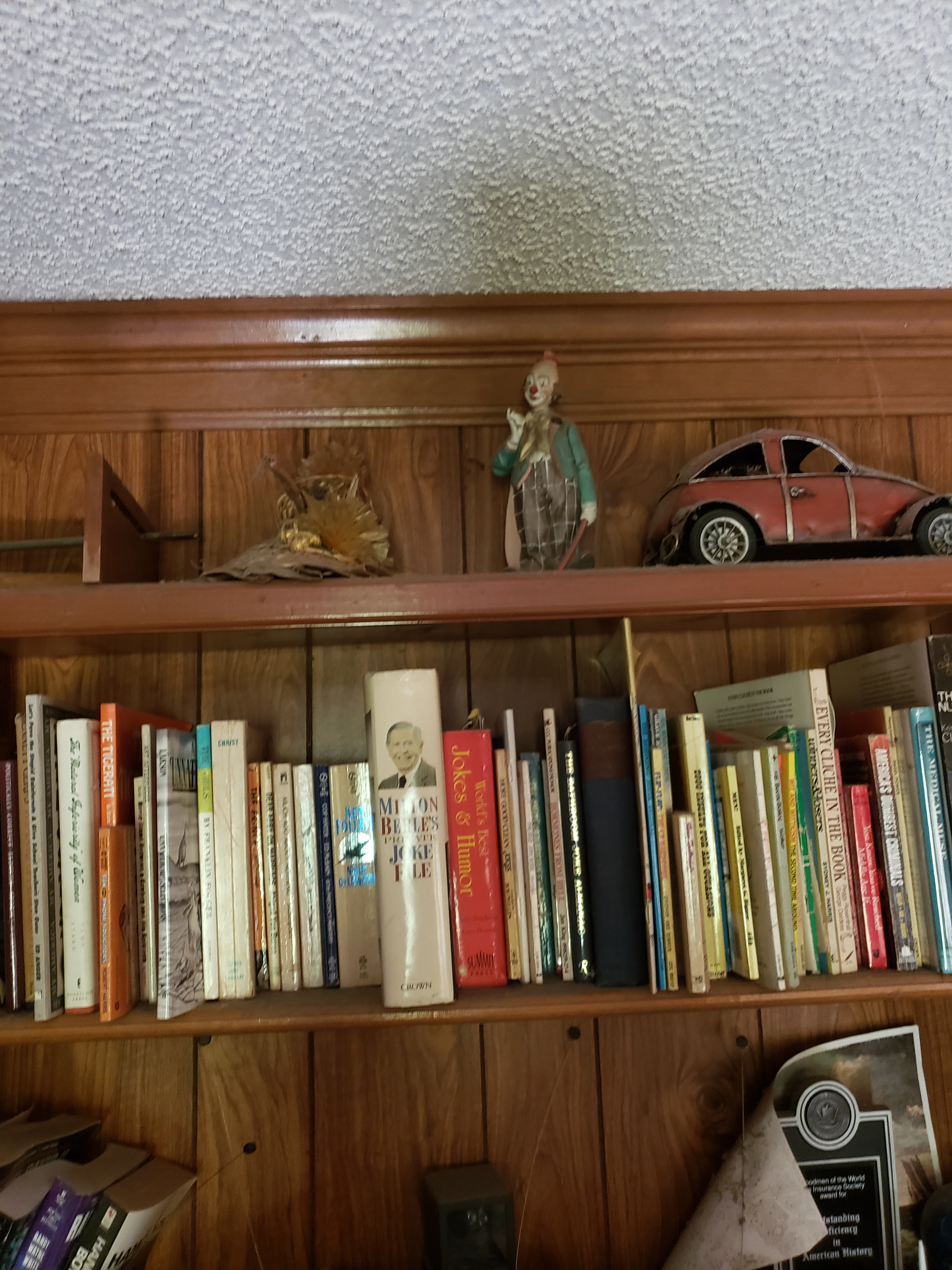
A troubling clown gazing down from the top of my dad’s bookshelf.
In a recent episode of the 538 podcast, Nate Silver, responding to a listener question about how voter turnout figures into his political forecasting model, points out that voter turnout is a concern for the pollsters and that they have methods for figuring how likely voter turnout should be represented in polling data. His work, he points out, is the aggregation of polling data. Silver argues that it is not a particularly useful conversation for him to critique the relationship between voter turnout and polling because that’s sophisticated work, and it’s not his area of expertise.
His comments remind me of another recent incident in the gaming industry. Jessica Price, a game developer for Guild Wars 2, was fired after a Twitter exchange with a fan. The fan suggested some “easy” fixes for a particular game design problem Price analyzed in a series of tweets, and Price called him out for mansplaining her own field to her.
Each of these moments spotlights the relationship between expertise and new media. The interactive, democratized world of new media encourages more conversation between “experts” in various fields and gives people a platform to both respond and be responded to publically in ways that really weren’t possible previously, unless you were the proud owner of a printing press and some number of avenues for distribution. Plenty of people write about the democratizing benefits of new media, and plenty of people excoriate this brave new world for its annihilation of civility.
New media allows information to operate like a wildfire, propagating and spreading without any authorities capable to containing that information, outside of a few firetrucks from traditional media outlets. There are pros and cons to information wildfires; on the one hand, the shooting of Michael Brown in Ferguson would not have been widespread news without Twitter. On the other hand, conspiracy theories peddled by all kinds of bad faith actors are also possible because of new media outlets.
What is the role of expertise in the world of new media then? Silver is a rare mitigating voice, an expert himself unwilling to comment on a technical detail that he hasn’t fully studied. Price’s story is more common; her expertise was questioned by a person who had no sense of his own ignorance on the topic. In the public discourse, it was not the fan’s ignorance that was punished but Price’s lack of civility. This story highlights not only the way expertise is understood in new media but also the ways in which expertise is gendered or otherwise privileged.
This tendency toward interactivity flattens, in many ways, the voices of experts. We all have Twitter accounts, so all of our voices are equally valid. Or at least people who have similar numbers of followers should be similarly valued. And this drowning out of expert voices is completely understandable. What role have experts traditionally played? Sources that grant authority to some voices have always privileged the already-powerful. Universities have long been the province of white men, white men still comprise the overwhelming majority of faculty at US universities, and the voices of people of color and women remain silenced. Education, though one way of establishing expertise, also requires membership in the dominant discourse.
With new media, there is a new class of public intellectual. Podcasters, bloggers, and YouTubers, most of whom are under-credentialed by the academy, are fully credentialed in terms of the number of followers they toll on various new media platforms. Upon my baptism in the waters of LeftTube, my initial observation was the way in which many LeftTubers engage with the writings and rhetoric of the alt-right. In traditional media, the ideas of the alt-right are rarely engaged, except as side notes after Charlottesville or a self-professed incel murderer. LeftTubers, however, are experts by the same method of popularity as the alt-right figures with whom they engage. The stakes of that discourse are important because, if expertise is not a factor, how then shall we value ideas?
In the 2004 film The Incredibles, the villain enacts a scheme to provide technology to all people in order to negate the need for superheroes. “Because when everyone is super,” he argues, “no one will be.” He’s wrong, though, and not just villainously so. His definition of superpowers does not actually differ from that the heroes against whom he rails. In fact, equally wrong are the Incredibles themselves and other proponents of superheroes, who long for the “good old days” when superheroes could just do whatever they wanted. It’s clear why the traditionally powerful might long for days of unchecked authority, but the benefits for the rest of us, born without the superpowers of cishet white maleness and/or inherited wealth, are murkier.
Democratization of ideas and information doesn’t have to look like widespread flattening. We don’t have to value all ideas in the same way or not at all. The opportunity afforded us by new media is the ability to bypass traditional barriers to knowledge, barriers that excluded marginalized and oppressed voices of all varieties. This new system doesn’t require the erection of new barriers; instead, we have the opportunity to imagine a new ideology that values the expertises each person has by disconnecting knowledge from capital.
Coming soon: Is New Media Liberatory? Part II: Disconnecting Knowledge from Capital



 In a
In a  inter(action)textuality(ies)